
A New Step in Oil and Gas Reservoir Geology:
Achievement of University of Tehran College of Science Researchers in Digital Assessment of Carbonate Rock Pores
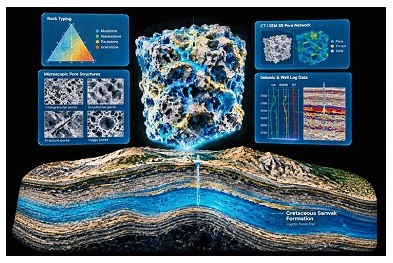 According to the Public Relations Office of the University of Tehran, researchers at the University of Tehran have improved geological modeling and optimization of reservoir development strategies by integrating conventional petroleum engineering approaches and Special Core Analysis (SCAL) with advanced imaging technologies, including Computed Tomography (CT) scanning and Scanning Electron Microscopy (SEM).
This research is the result of the joint efforts of Dr. Hamzeh Mehrabi, a faculty member of the College of Science, Sepideh Darvishi, a PhD student at the University of Tehran, and Dr. Elham Talebi, a researcher at the University of Tehran, addressing one of the most challenging aspects of oil and gas reservoir characterization.
Regarding this research, Dr. Mehrabi stated: "Identifying the complex pore structure in carbonate reservoirs due to the phenomenon of 'multi-scale heterogeneity' has always been one of the main obstacles for petroleum engineers and geologists. In conventional petrophysical methods, pore geometry and size are usually estimated indirectly, which introduces errors in the accurate prediction of fluid behavior in the reservoir. On the other hand, carbonate rocks of the Sarvak Formation in the Zagros sedimentary basin (located in the Abadan Plain), with their diverse facies and complex diagenetic processes including compaction and dissolution, represent a prominent example of these complexities."
He added: "To overcome these limitations, we succeeded in developing a comprehensive and novel workflow. In this research, conventional petroleum engineering approaches and Special Core Analysis (SCAL) have been precisely integrated with advanced imaging technologies, including Computed Tomography (CT) scanning and Scanning Electron Microscopy (SEM)."
Dr. Mehrabi emphasized: "Quantitative comparison among pore facies, hydraulic units, pore size classes, and CT-based rock types showed that the obtained digital rock types establish the strongest link between microscopic rock characteristics, pore geometry, and fluid flow behavior. Geological tracing of these rocks reveals how the pore structure has evolved from compacted mudstones and micropores to grainstones with large vugs and fracture networks."
Regarding the practical aspects of his research, he stated: "By bridging the gap between pore geometry at the micro-scale and fluid flow behavior at the macro-scale, this research has provided a predictive and reliable model for assessing storage capacity and fluid flow dynamics in carbonate reservoirs, which can be used to improve geological modeling and optimize reservoir development strategies."
Those interested in reading the full text of this article can refer to the following link in the journal Petroleum Research:
https://www.sciencedirect.com/science/article/pii/S2096249526001092

Your Comment :