
New Achievement by University of Tehran Researchers:
Dermal Tattoos as a New Generation of Intradermal Wearable Medical Devices
According to the Public Relations Office of the University of Tehran, Dr. Mohammad Ali Khayamian, a faculty member of the Institute of Biochemistry and Biophysics, along with Dr. Reyhaneh Shakibi, Ali Golkar, and Hamidreza Bagheri, researchers and students of the institute, have unveiled the opportunities, challenges, and the path ahead for this emerging technology in an article.
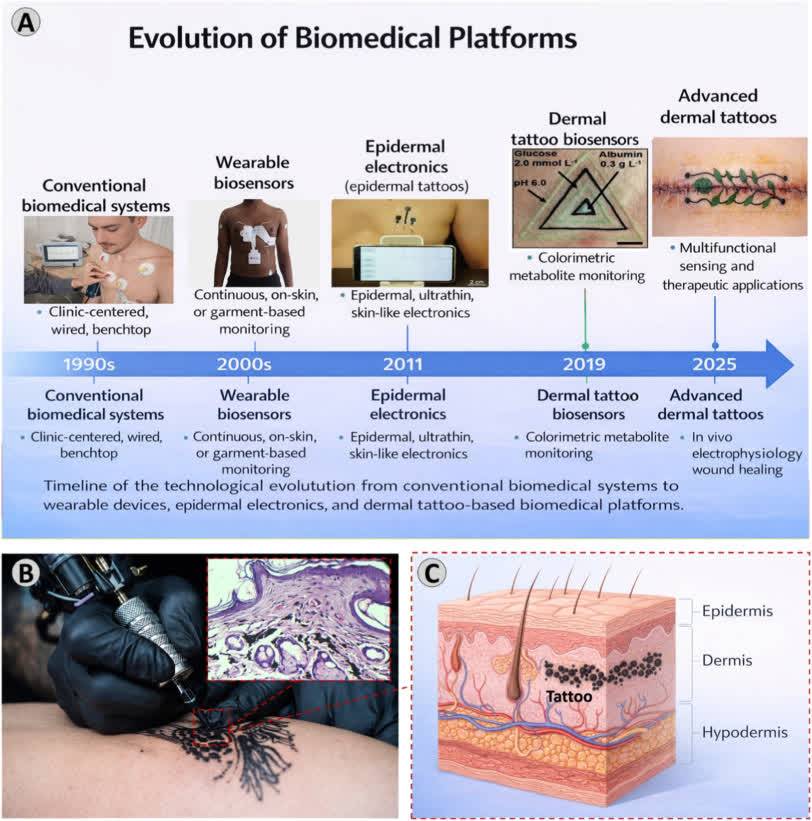
Dr. Mohammad Ali Khayamian, a faculty member of the Institute of Biochemistry and Biophysics, pointing to the main difference between dermal tattoos and conventional wearable devices, said: “The main difference lies in the location. Wearable devices are placed on the skin surface, and epidermal electronics also mainly operate on the outer layer of the skin, but dermal tattoos are placed within the dermal layer, where they have direct access to interstitial fluid.”
He added: “This location creates important advantages: stable tissue integration, protection from surface contamination and mechanical damage, and access to biomarkers whose concentrations correlate with blood.”
The faculty member of the Institute of Biochemistry and Biophysics, regarding the current applications of this technology, stated: “The reported tattoo systems include a diverse range: colorimetric types that respond to chemical changes with color change, fluorescent systems whose light intensity changes, photoresponsive systems, living tattoos, and electrophysiological systems. Current applications are mainly focused on monitoring biomarkers such as glucose, electrolytes, ultraviolet radiation exposure, and physiological electrical signals.”
Dr. Khayamian, pointing to the expansion of this technology into the treatment domain, emphasized: “Recently, we are witnessing expansion into the treatment domain. Self-powered bioelectronic systems for wound healing and transient and bioresorbable therapeutic interfaces are among these advancements. This trend shows that dermal tattoos can transform from a mere diagnostic tool into an integrated therapeutic platform.”
Regarding the challenges of clinical translation of this technology, he said: “There are several fundamental challenges: First, most reported systems remain at the proof-of-concept stage and lack sufficient in vivo validation. Second, the absence of standard criteria for evaluating performance and comparing systems. Third, limited data on the long-term safety of biocompatible materials in dermal tissue. Our experience in developing nanosensors and bioelectronic systems shows that the path from laboratory to clinic requires close collaboration among materials scientists, engineers, biologists, and clinical physicians.”
This biophysics researcher, regarding the future of this field, noted: “I am optimistic about this field. The combination of smart, biocompatible materials and the ability for non-invasive reading has the potential to create fundamental changes in personal health monitoring and precision medicine. But we must be realistic; this path requires investment in clinical research, development of standards, and extensive interdisciplinary collaboration. If these infrastructures are provided, dermal tattoos can become one of the pillars of preventive and personalized medicine.”
It is worth mentioning that this article titled “Dermal tattoos in biomedicine: Emerging platforms for sensing and therapy” was published in the prestigious journal Materials Today Bio. This journal, with an impact factor of 11, is among the top 10% of journals in the field of materials science and is recognized as a globally authoritative reference. This article examines the potential of dermal tattoos as emerging platforms for sensing and therapy in the field of biomedical engineering, and the results of this research could be an important step in the development of new medical technologies.
https://www.sciencedirect.com/science/article/pii/S2590006426007568

Your Comment :