
Indonesian Ambassador: Iran–Indonesia Relations Should Advance Toward Practical Cooperation in Science and Technology
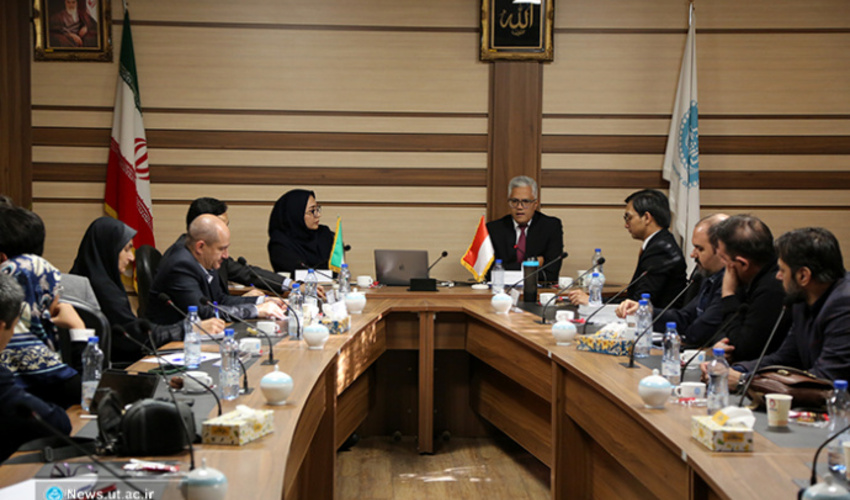
A specialized academic meeting was held on October 28, 2025, to mark the 75th anniversary of diplomatic relations between Iran and Indonesia. The event was organized by the Department of Regional Studies at the University of Tehran, the Iranian Association for Regional Studies, and the Asia-Pacific Scientific Association, and took place at the Conference Hall of the Center for Advanced International Studies, Faculty of Law and Political Science, University of Tehran.
Ruliansyah Sumirat, Ambassador of the Republic of Indonesia to Tehran, emphasized the significance of the 75-year diplomatic relationship between the two countries and stated, “Tehran–Jakarta relations have reached a stage where they must evolve from political engagement to practical cooperation in science and technology.”
Highlighting the importance of people-to-people connections, particularly among academic communities, for mutual understanding, the ambassador announced new initiatives to expand student and faculty exchanges. “We will utilize all available capacities to strengthen academic collaboration,” he added.
Ambassador Sumirat identified higher education and the enhancement of human resource quality as key priorities of his government. Addressing universities and research centers in both countries, he stressed the need to reduce scientific dependence on developed nations by establishing a joint network in strategic fields such as information technology, artificial intelligence, clean energy, and marine sciences.
In another part of his speech, the ambassador elaborated on Indonesia’s geopolitical and economic perspectives. He explained that Indonesia pursues a policy of “balanced engagement” with global powers and does not take sides in the competition between China and the United States. Instead, Indonesia seeks economic cooperation with all parties, based on mutual respect.
He also called for a redefinition of international institutions and highlighted the South–South cooperation model as a platform for developing countries to play a more active role. “Developing nations must enhance their bargaining power in the global economic system by forming coalitions such as BRICS and ASEAN,” he said.
Referring to Iran and Indonesia’s shared membership in organizations such as the Organization of Islamic Cooperation, the Non-Aligned Movement, and BRICS, Sumirat emphasized the need for synergy and collaboration between the two countries in addressing challenges facing the Islamic world, the region, and the globe.
In the final segment of his speech, the ambassador outlined three strategic priorities of Indonesia in global affairs. He reaffirmed his country’s opposition to all forms of unilateral sanctions and stressed the importance of resolving Iran’s nuclear program through diplomacy. “Indonesia supports the right of all nations to peaceful use of nuclear energy,” he declared.
Given Indonesia’s status as an archipelagic nation, Sumirat called for scientific cooperation between Iran and Indonesia in areas such as maritime governance, energy security, climate change, and the blue economy. “The sea must become a unifying force and a model for sustainable development,” he said.
Following his address, the ambassador responded to questions from participants on various international issues.
At the beginning of the session, Dr. Hamzeh Safavi, Head of the Department of Regional Studies at the Faculty of Law and Political Science, called for the expansion of bilateral relations, particularly academic cooperation, between Iran and Indonesia. He expressed hope that such collaboration would be strengthened and operationalized through the signing of memoranda of understanding and agreements between universities in both countries.

Your Comment :