
University of Tehran Professor’s Invention Receives International Patent Registration
According to the University of Tehran’s Public Relations Office, the international invention “Electroporation/Electrochemotherapy of Surgically Sensitive Regions”, led by Dr. Mohammad Abdolahad, a professor at the College of Engineering, University of Tehran, has been granted by the United States Patent and Trademark Office (USPTO). The patent, numbered US 12,746,388 B2, was registered with the USPTO on September 29, 2026.
The invention resulted from the national stage of PCT/IB2023/058455 and was published under WO2025/046258. Its registered title is “ELECTROPROPATION/ELECTROCHEMOTHERAPYOF SURGICALLY SENSITIVE REGIONS,” and the list of inventors includes Dr. Mohammad Abdolahad and a group of researchers and physicians, including Dr. Seyed Ruhollah Miri and Dr. Habibollah Mahmoudzadeh.
The electrochemotherapy technology for sensitive and surgically difficult regions enables the application of electrochemotherapy in sensitive and difficult areas of the body through the design of non-invasive/minimally invasive electrodes and the use of vacuum and magnetic fields.
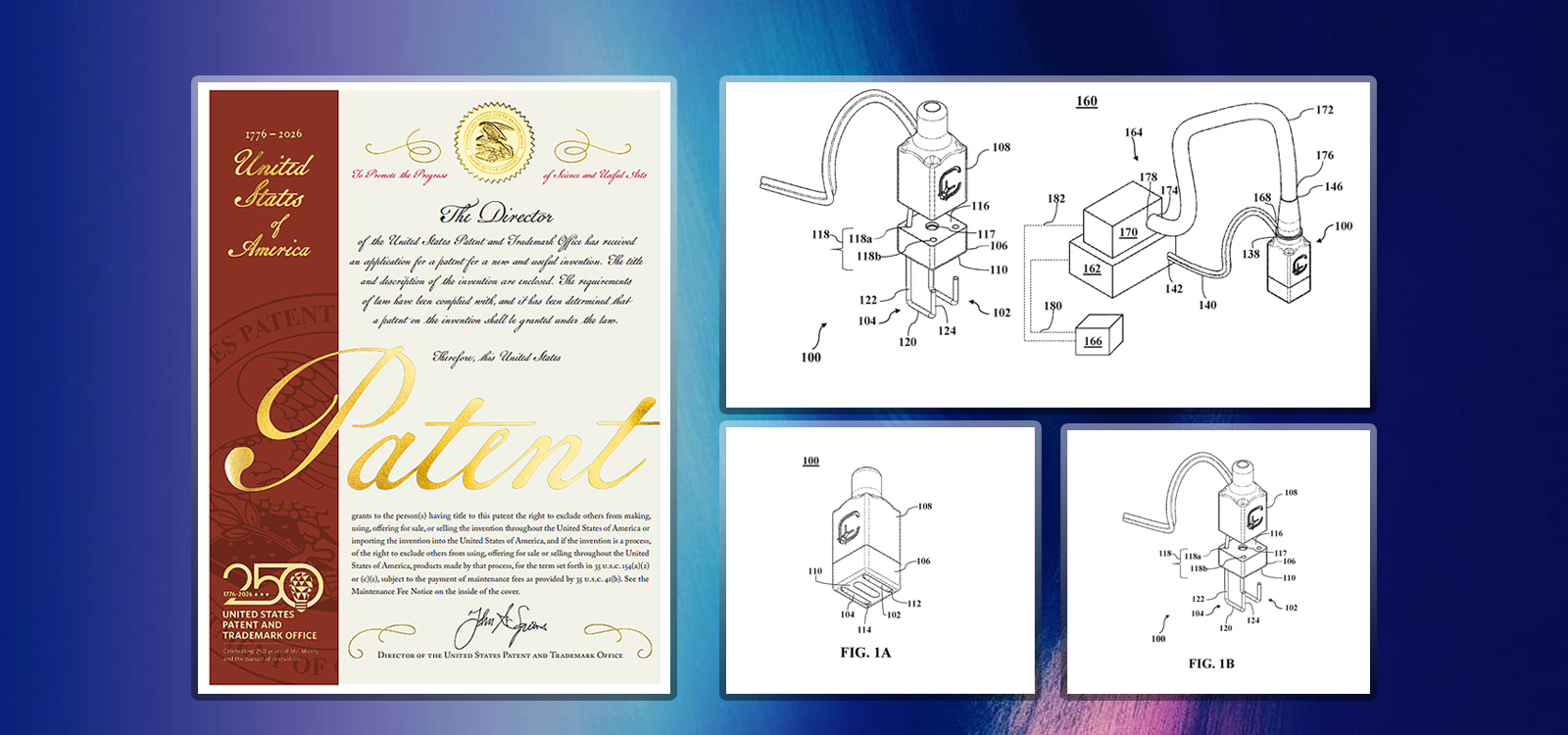
According to the patent text and diagrams, the technology introduces two main systems:
Vacuum-assisted superficial electroporation probe. This probe includes U-shaped blade electrodes that are placed in superficial contact with tissue. By applying vacuum in the range of -0.5 to -0.7 bar, the tissue is drawn toward the electrodes, establishing complete and uniform contact. Electrical pulses—for example, 8 square pulses with an amplitude of 500 to 1,500 V/cm and a duration of 100 microseconds—are then applied for electroporation. This design prevents bleeding, tearing, or damage to sensitive tissues.
Intracorporeal electroporation device with a flexible magnetic electrode. In this system, a chain of spherical magnets is inserted flexibly into the body, and an external magnetic plate electrode or ferromagnetic steel guides its movement. A camera attached to the first magnet tracks the electrode’s position. This method is designed for hollow organs and ducts such as the intestine, esophagus, vagina, stomach, duodenum, colon, cervix, and uterus.
Regarding the significance of the invention, conventional needle electrodes used in electrochemotherapy pose risks of bleeding and perforation of vital organs in sensitive tissues such as blood vessels, nerves, and intestines. Plate electrodes also do not provide sufficient effective contact. The new technology, with its non-invasive/minimally invasive design, enables access to difficult areas and the application of an electric field with minimal damage.
In the patent examples, in BALB/c mice with 4T1 breast tumors, the treated group showed a significant reduction in tumor size on days 4 and 7, while the control group showed no such reduction. In New Zealand rabbits, electroporation of the rectum and rectosigmoid region was also performed, and CT imaging 12 days later showed no tissue damage caused by electrode insertion and electroporation stimulation.
This achievement is the result of collaboration between the fields of cancer bioelectronics and cancer surgery. Dr. Mohammad Abdolahad, a professor at the College of Engineering, University of Tehran, and winner of the 2019 Mustafa Prize, contributed alongside Dr. Seyed Ruhollah Miri, Associate Professor of Cancer Surgery and Head of the Cancer Institute, and Dr. Habibollah Mahmoudzadeh, Professor of Cancer Surgery at the Cancer Institute.
This technology could represent an important step in the development of a new generation of localized cancer therapies—therapies aimed at increasing efficacy against tumors and reducing damage to healthy tissues and vital structures. The current results are preclinical, and its clinical path requires further studies.

Your Comment :