
University of Tehran College of Engineering Achievement:
Development of a Specialized Biological Ink Based on Natural Body Materials for 3D Bioprinting
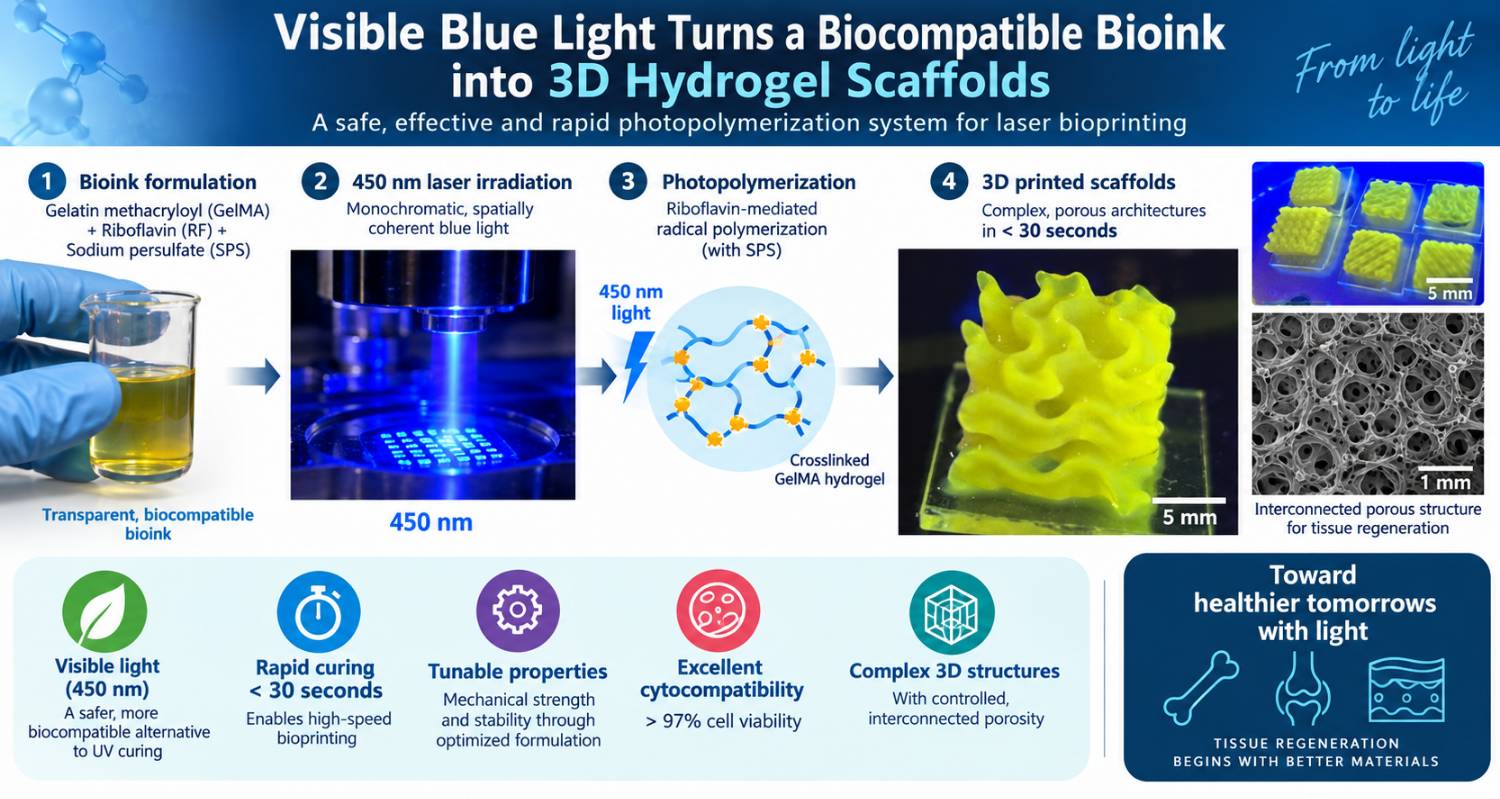
According to the Public Relations Office of the University of Tehran, researchers from the Faculty of Mechanical Engineering, in two studies published in highly reputable scientific journals, succeeded in developing a specialized, visible-light-sensitive bioink based on natural body materials after designing and fabricating DLP/DMD-based bioprinting equipment and developing a process for the synthesis and evaluation of gelatin methacryloyl (GelMA). This achievement could serve as an effective step toward advancing tissue engineering and regenerative medicine technologies.
One of the key challenges in 3D bioprinting and tissue engineering is the development of safe, biocompatible bioinks suitable for fabricating living tissues. In this regard, a joint study was conducted at the University of Tehran by Dr. Mohsen Hamedi and Ramiar Hosseinzadeh, the results of which have been published in two scientific papers in international journals.
The study aimed to develop bioinks based on natural materials present in the human body, so that while maintaining biocompatibility, they could be used in regenerative medicine and tissue engineering applications.
In the first step, the researchers produced and characterized gelatin methacryloyl (GelMA), a biomaterial that is now considered one of the most widely used materials in 3D bioprinting. Gelatin is a substance derived from collagen, and collagen is the most abundant structural protein in the human body, forming a major part of the extracellular matrix of many tissues.
In this study, the process of gelatin methacrylation and the attachment of methacrylate groups to the gelatin protein structure were investigated. Methods were also developed to quantify the degree of methacrylation and to accurately determine the degree of chemical modification of gelatin. The results showed that precise control and measurement of the degree of methacrylation play an important role in regulating the mechanical properties, crosslinking density, structural stability, and biological performance of the resulting hydrogels, and could contribute to standardizing GelMA production in tissue engineering research.
Subsequently, building on the results of this stage, the researchers in the second step developed a visible-light-sensitive bioink. In this system, gelatin methacryloyl was used as the base material and riboflavin (vitamin B2) as the photoinitiator. Riboflavin is one of the natural vitamins present in the human body, capable of being activated by blue light at a wavelength of approximately 450 nanometers.
The use of visible light instead of ultraviolet radiation is one of the main advantages of this research, as it can reduce the risk of damage to living cells and tissues. Experimental results showed that the developed system is capable of producing hydrogels with suitable mechanical properties, favorable printability, and high biocompatibility.
Dr. Hamedi commented on the significance of the research: “One of the main objectives of these studies was to develop systems for bioprinting that use natural and biocompatible materials as much as possible and reduce the risks of the conventional ultraviolet light approach. Gelatin derived from collagen and riboflavin as a natural vitamin printable with visible light make it possible to design safer bioinks and reduce cell membrane damage for tissue engineering and regenerative medicine applications.”
Engineer Hosseinzadeh, a researcher on the project, also stated: “This research began with the synthesis and quantification of GelMA and subsequently led to the development of a visible-light-sensitive bioink. The results indicate that by using natural materials present in the body, it is possible to design systems with suitable performance for bioprinting and tissue regeneration, which have high potential for development in future medical applications.”
The researchers believe this achievement could pave the way for the development of a new generation of biological scaffolds and 3D-printed constructs for regenerating tissues such as bone, cartilage, skin, and other damaged tissues.
The results of these studies have been published in two Q1 international journals with impact factors of 7.9 and 8, respectively:
• https://www.sciencedirect.com/science/article/pii/S259012302602030X
• https://www.sciencedirect.com/science/article/pii/S2590049826002547
This research was conducted in line with the development of new tissue engineering and regenerative medicine technologies and the expansion of 3D bioprinting applications in treating diseases and regenerating damaged tissues.

Your Comment :