
University of Tehran Researchers, After Examining Nearly 62,000 Tourism Destinations, Report:
One-Fifth of Iran in the Red Heat Zone; Which Tourism Destinations Are Most at Risk?
According to a report by the Public Relations Office of the University of Tehran, Motahareh Abbasi Noodeh and Mohammad Farhadi, students of the Faculty of Environment, together with Dr. Hamideh Mahmoodi and Dr. Mohammad Karimi Firozjaei, faculty members of the University of Tehran, conducted this study based on the IPCC vulnerability framework.
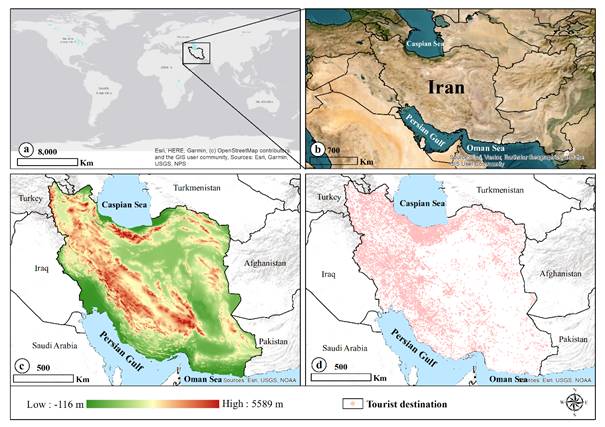
They integrated climatic data, remote sensing data, water resources, vegetation cover, and service infrastructure for the summers of 2020 to 2025 (1399–1404 in the Iranian calendar) in a Geographic Information System (GIS) at a resolution of 1 km, and assessed the status of 61,945 tourism destinations from three aspects: the degree of heat exposure, sensitivity, and adaptive capacity.
According to the results, about 31 percent of the country's territory is exposed to high and very high heat exposure. The highest vulnerability is observed in the center, southwest, and south of Iran, while the northern and northwestern regions are in a better condition. In a comparison of provinces, Qom with 96 percent, Khuzestan with 79 percent, Bushehr with 74 percent, and Tehran with 68 percent of their area falling into the two high-vulnerability groups topped the list. In contrast, in Kurdistan, Ardabil, North Khorasan, and Sistan and Baluchestan, this share falls below 4 percent.
Dr. Hamideh Mahmoodi, a faculty member of the Department of Tourism Management at the University of Tehran, considers the significant difference among various types of destinations to be one of the most important findings of the research. About 77 percent of food service establishments fall into the two high and very high vulnerability groups. This share is 70.5 percent for recreational and service centers, 70 percent for accommodation centers, and 62.5 percent for religious destinations. Historical destinations are in an intermediate condition (49 percent). Natural destinations showed the lowest vulnerability at 32 percent.
According to Dr. Mahmoodi, the main reason for the vulnerability of service facilities is their concentration in dense and hot cities. In contrast, vegetation cover and water resources protect natural destinations. Therefore, protecting nature, in addition to its environmental importance, is also considered a heat adaptation strategy. The weight analysis of factors also showed that among climatic factors, maximum temperature is the most important exposure factor. Among adaptation factors, access to medical centers is of the greatest importance, followed by vegetation cover and proximity to water resources.
The researchers emphasize that each type of destination requires its own specific solution. For historical buildings, adjusting visiting hours and heritage-compatible shading are recommended. For religious destinations, crowd management and the creation of shaded spaces and access to water are priorities. For high-risk destinations, early warning systems, medical service preparedness, and emergency management plans are essential. According to the researchers, planning to cope with heat must move from the level of general policies to the level of management at each destination.
This research has been published under the title "Mapping heatwave vulnerability of tourism destinations under IPCC framework: a national GIS-based assessment for Iran" in the journal Results in Engineering, which has an impact factor of 9.4.
https://www.sciencedirect.com/science/article/pii/S2590123026042994

Your Comment :